

Most SEOs pick a keyword, check the difficulty score, and start writing. That’s the same as studying for the wrong exam. The SERP is telling you exactly what Google wants to rank — and most people never bother to read it.
SERP insight isn’t a tool or a metric. It’s a discipline. And once you develop it, keyword research changes completely.
The Problem: You’re Optimizing Blind
You’ve done your keyword research, and found a term with solid volume and manageable difficulty. You’ve written a 2,000-word article that covers the topic well. Then it sits at position 22 for eight months.
Sound familiar?
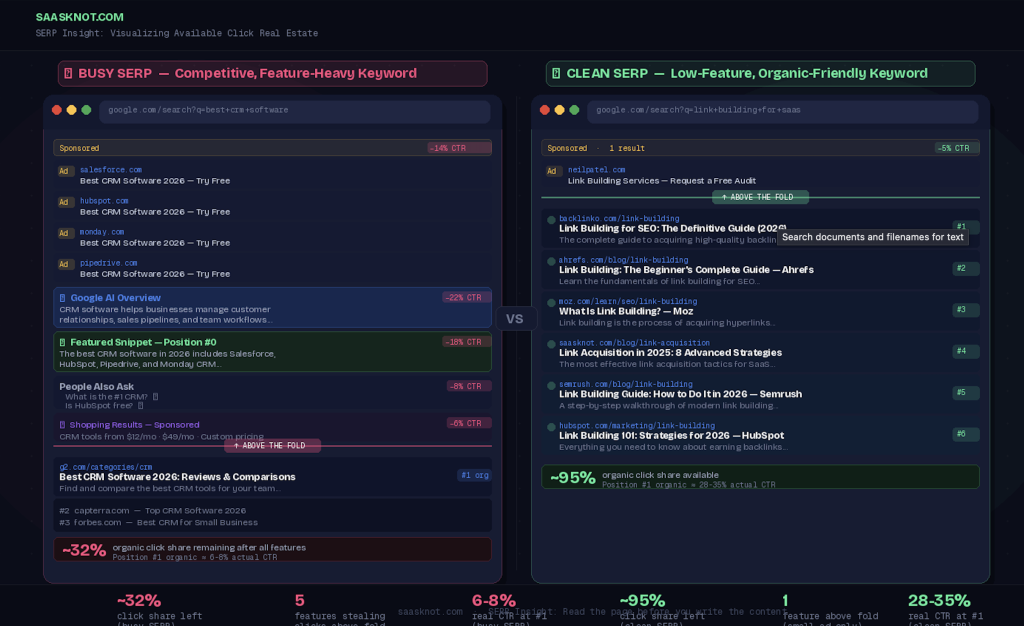
The issue isn’t the content. It’s that you never studied the SERP before writing. You didn’t ask: What does Google actually reward here? Is the intent informational or commercial? the position one owned by a domain with 5 million backlinks, or a three-year-old blog that got lucky? Is there a Featured Snippet eating 30% of the clicks before any blue link gets touched?
You can’t win a race if you haven’t looked at the track. Most SaaS companies are so focused on acquiring links that they skip the pre-write audit entirely. That’s a compounding mistake — here’s how organic SEO actually works before backlinks enter the picture.”
What Most People Get Wrong About SERPs
The dominant advice is: target low-difficulty keywords and you’ll rank. Keyword difficulty is a useful proxy, but it’s a blunt one. It measures how strong the linking profiles of current page-one results are. It does not measure how well those results actually satisfy search intent.
Here’s the contrarian truth: a high-difficulty keyword with poor intent-match on page one is often easier to crack than a low-difficulty keyword with perfectly optimized competitors.
If the top 10 results for a keyword are all thin listicles from 2019 and you publish a thorough, updated guide with original data, you have a real shot — regardless of what Ahrefs says the difficulty is.
The metric most SEOs ignore entirely is SERP insight volatility: how frequently the top 10 positions change. A volatile SERP means Google hasn’t found a result it’s truly satisfied with. That’s your signal. A stable SERP where the same pages have held position one through five for 24 months is a much tougher fight, even if the difficulty score looks approachable.
The SERP Intelligence Framework 2026
Think of every Google results page as a brief from your competitor’s strategy team. It tells you five things, if you know where to look:
1. Intent signal. What format dominates page one? If it’s mostly long-form guides, Google wants education. If it’s product pages or comparison posts, the intent is transactional. Write the wrong format and you won’t rank, no matter how good the content is.
2. Feature density. Count how many SERP features sit above the first organic result: AI Overview, Featured Snippet, People Also Ask, ads, video carousel. Each one eats clicks. According to Semrush’s 2024 SERP insight analysis, AI Overviews appeared on roughly 14% of informational queries by mid-year and that number has been climbing. A keyword that looks like 3,000 monthly searches might deliver 400 actual clicks And if your domain authority is thin, even a clean SERP won’t save you — which is why link acquisition strategy needs to run parallel to your SERP analysis.
3. Content age. If Google is showing articles from 2022 and 2023 on a fast-moving topic, freshness is your edge. Publish something current, update it quarterly, and you’ll often leapfrog older pages regardless of their authority.
4. Domain diversity. If three of the top five results are from the same domain, Google is already showing a preference signal. It’s a harder keyword to break into. If all five results come from different sites, the door is wide open.
5. SERP real estate. Count the organic results actually visible above the fold on desktop and mobile. For many competitive keywords in 2026, there are zero organic results above the fold on mobile. You need to win the Featured Snippet or a People Also Ask box — not just rank — to actually get seen.
This five-point read takes about four minutes per keyword. Most SEOs skip it entirely.
How to Build Real SERP Insight, Step by Step
Search the keyword in incognito and read the SERP cold
Before touching any tool, open Chrome incognito, search your target keyword, and spend 60 seconds reading what you see. Notice what dominates the page. Notice what’s missing. Your unbiased first impression is more honest than any tool output.
Use this for: any keyword before you commit to creating content around it.
Run a SERP feature audit for your target keyword
Go into Semrush or Ahrefs, pull up the SERP insight overview for your keyword, and log every feature present: Featured Snippet (Y/N), AI Overview (Y/N), People Also Ask (Y/N), number of ads, image pack, video carousel, local pack. Build a simple scoring system: each feature costs you 10% of projected click volume. A keyword with five features active may not be worth the effort at all, even with strong rankings.
Example: A SaaS content team targeting “what is a data pipeline” found the keyword had 4,400 monthly searches. After accounting for an AI Overview, a Featured Snippet, and two ads, estimated organic CTR for position one dropped to around 6%. They reallocated that effort to a lower-volume keyword with a clean SERP and pulled in 3x more traffic.
Analyze the content format of the top 3 results
Open the top three ranking pages for your keyword. Don’t read them — scan the structure. Are they long-form guides, short definitions, comparison tables, or tool roundups? This tells you the format Google expects. Deviation from this format, without a very strong reason, is one of the top causes of ranking failure.
Check the SERP for “Position 0” opportunity
If there’s a Featured Snippet, look at the page currently holding it. Is it a weak answer, a short paragraph that doesn’t fully address the question? That’s a displacement opportunity. Structure your content with a direct 40-60 word answer to the query immediately under your H2. Keep the language simple. This format is also what AI engines like Perplexity and ChatGPT extract when generating citations.
Track SERP volatility over 30 days before investing resources
Use Semrush’s Position Tracking or SERPWatcher to monitor how the top 10 results shift for a keyword over 30 days before you write. If positions are shuffling weekly, that’s a green light. Google is unsatisfied with existing content. If position one has been locked for 18 months, raise your standards before investing. Getting indexed fast matters too — especially when you’re trying to displace a stale result. Rapid URL Indexer can dramatically cut the lag between publish and crawl.
Map what’s genuinely missing from page one
The final step is the most valuable and the most skipped. Read all three top-ranking articles for your target keyword. Write down every question a reader would still have after reading all three. That gap list is your content brief. Fill those gaps and you don’t just compete — you become the most useful result on page one, which is the only outcome that produces durable rankings.
Common Mistakes to Avoid
Treating keyword difficulty as a binary green/red signal. A difficulty score of 45 doesn’t mean you can’t rank. It means the average linking profile of current results is strong. If those results are outdated, misaligned with intent, or thin on depth, difficulty is almost irrelevant. Always combine difficulty with a manual SERP read.
Ignoring the mobile SERP. Most SEO analysis happens on desktop. But if your audience is mobile-first, the SERP you need to analyze is the mobile one. Features stack differently on mobile — AI Overviews take up significantly more screen space, and the fold sits much higher. A result that’s “above the fold” on desktop may be the fourth scroll on mobile.
Writing for the keyword instead of the SERP intent. This is the mistake that produces the most ranking failures. A page can use a keyword perfectly and still not rank because it answers a different question than what searchers actually want. Search “best CRM for startups” and you’ll see comparison posts, not product pages. Write a product page for that keyword and Google will never show it, regardless of how optimized it is. This is the same reason why choosing the wrong SaaS link building agency — one that builds links without SERP research — produces zero ROI. Links to the wrong page type don’t rank.
Real-World Example: Before and After a SERP Audit
A B2B SaaS company was targeting the keyword “sales automation software” with a product landing page. Monthly searches: 8,100. Keyword difficulty: 62. They’d had the page up for 14 months and were stuck around position 28.
SERP audit findings: page one was entirely occupied by comparison articles, roundups, and “best of” listicles. Not a single product page ranked in the top 20. The intent was clearly informational/comparative, not transactional.
They created a new comparison article titled “7 Sales Automation Tools Compared: Pricing, Features, and What No One Tells You.” Within 11 weeks, it ranked at position 7. The product page remained unchanged and eventually started ranking for more transactional long-tail variants where the SERP actually showed product pages.
Same keyword. Different SERP insight. Completely different outcome.
Quick-Reference Summary
SERP insight is the practice of analyzing Google’s first page before writing, using it as a competitive intelligence brief rather than just a rankings display.
Key signals to read: intent format, feature density, content age, domain diversity, and available organic real estate above the fold.
SERP volatility — how often the top 10 shifts — is a stronger opportunity signal than keyword difficulty alone.
Featured Snippet optimization (40-60 word direct answers under H2s) doubles as AI citation optimization for Perplexity, ChatGPT, and Google’s AI Overview.
A keyword with 1,000 monthly searches and a clean SERP will often outperform a 5,000-search keyword buried under six SERP features.
Frequently Asked Questions
What is SERP insight and why does it matter for SEO?
SERP insight is the practice of analyzing a search engine results page before creating content. It reveals search intent, identifies which content formats Google rewards, and shows how much organic click share is actually available. Without it, you’re optimizing for a keyword without understanding the competitive environment around it.
How do I check what SERP features are active for a keyword?
Use Semrush’s Keyword Overview or Ahrefs’ Keywords Explorer — both show which SERP features appear for a given query. You can also search the keyword in incognito mode and manually log what appears. Track features like AI Overview, Featured Snippet, People Also Ask, ads, image packs, and local packs.
Does keyword difficulty accurately reflect how hard it is to rank?
Not entirely. Keyword difficulty scores measure the average backlink strength of current page-one results. They don’t account for intent mismatch, content age, or SERP volatility. A high-difficulty keyword where results are outdated or poorly aligned with intent can be easier to rank for than a low-difficulty keyword with highly optimized competitors.
What is SERP volatility and how do I use it to find opportunities?
SERP volatility refers to how frequently the top 10 positions change for a given keyword. High volatility means Google is unsatisfied with current results — that’s a signal to target that keyword aggressively. Tools like SERPWatcher and Semrush’s Position Tracking can show historical rank movement for any keyword.
How do I optimize content to appear in AI-generated answers and citations?
Write a clear, direct answer (40-60 words) to the core question immediately under an H2 heading. Use simple, declarative sentences. Include an original definition of a key concept. These structures are the primary format that ChatGPT, Perplexity, and Google’s AI Overview use when pulling citations from external pages.
If you’ve been choosing keywords based on volume and difficulty alone, you’ve been playing with half the deck. The SERP is a document — read it before you write anything. If you’re ready to act on what you find in the SERP, the next step is building authority on the pages that deserve to rank. Start with link building in SEO — a full breakdown of how it works and where to begin.